Astigmatism means the front surface of your eye is shaped a little more like a football than a basketball. Light entering it focuses at more than one point instead of a single sharp one.
It is extremely common, it is not a disease, and it is correctable with glasses or contact lenses.
What it looks like
Because light focuses unevenly, the effect is not simply blur. People describe:
- Blur at all distances rather than only near or far
- Letters that look slightly doubled or shadowed
- Streaking or starbursting around lights at night
- Squinting, which briefly sharpens things
- Eye strain or headaches after concentrated work
Night driving is often where it is most noticeable, because point sources of light show the distortion clearly.
How it is measured
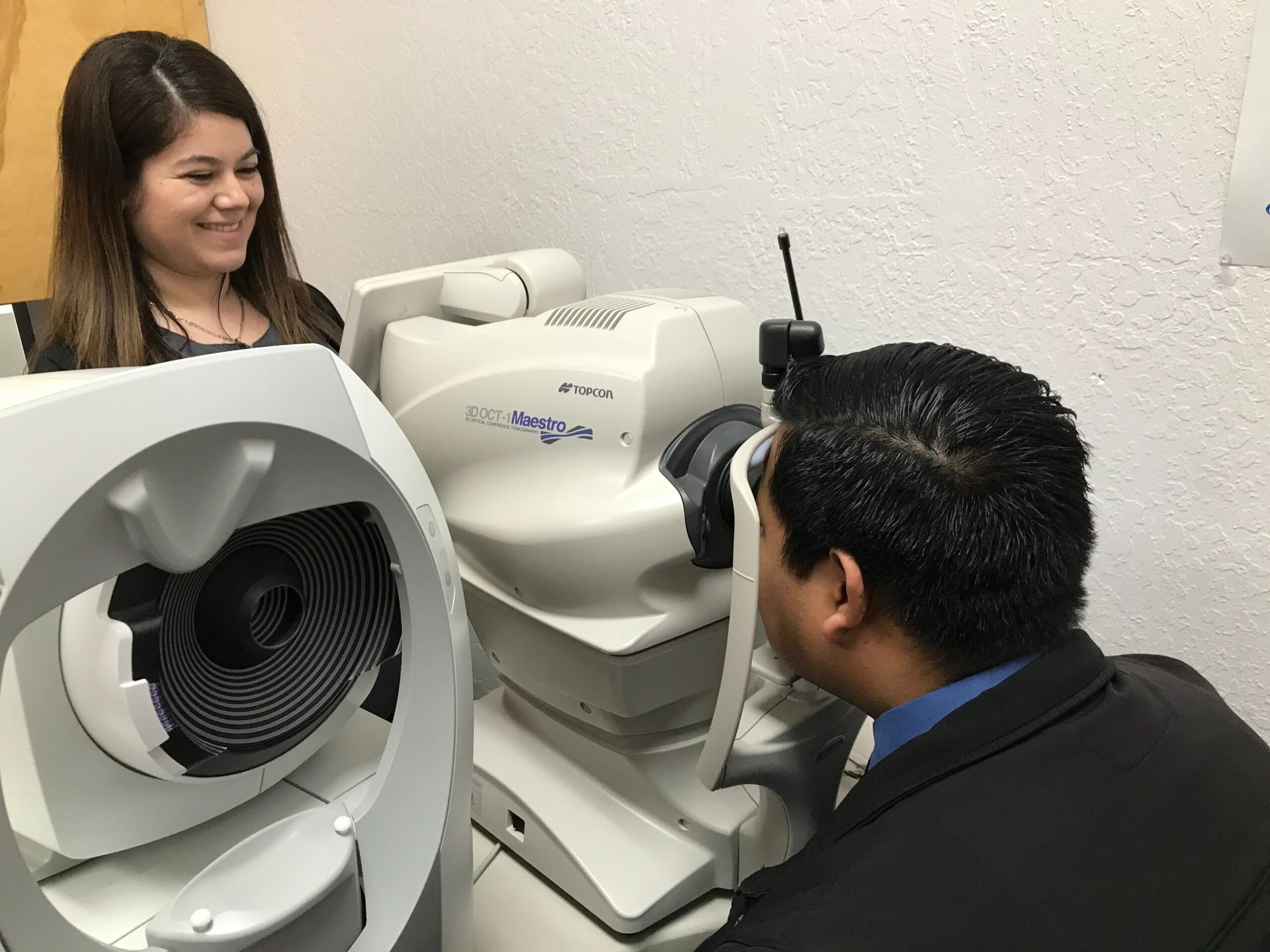
Astigmatism is measured at every comprehensive exam. Pretesting with the auto-refractor gives an estimate, and Dr. Prewett refines it during the refraction.
On your prescription it appears as two numbers travelling together. Cylinder is the amount of correction, and axis is the orientation, written between 1 and 180. Axis is an angle, not a strength. See what the numbers on your glasses prescription mean.
Does it get worse?
It can change over time, particularly in childhood and the teens, and often shifts gradually in adulthood.
What matters more than a small change is a rapid or unusual one. A noticeable increase in astigmatism over a short period is worth investigating, since corneal conditions can present that way. That is one of the reasons we compare each exam against your previous ones rather than treating a prescription as a fresh measurement each time.
What does not cause it
A few myths worth retiring:
- Reading in dim light does not cause astigmatism
- Sitting close to a screen does not cause it
- Rubbing your eyes occasionally does not cause it, though persistent vigorous rubbing is worth avoiding
- It is not caused by wearing the wrong glasses
Most astigmatism is simply the shape you were born with.
Correcting it
Glasses correct it with a lens ground to counter the uneven curve. If your astigmatism is significant and it has been uncorrected, new glasses can feel odd for a few days while you adapt, because the world is being reshaped slightly. That settles. See why new glasses sometimes feel strange at first.
Contact lenses correct it with toric lenses, which are weighted so they stay oriented on the eye. This is why fit matters more than usual, and why a contact-lens fitting is a separate process. See regular eye exam vs. contact-lens exam.
In children
Uncorrected astigmatism can make reading tiring and affect how comfortably a child works up close, and children rarely report it because they assume everyone sees that way.
It is one of the things a full exam checks and a chart screening can miss. See eye exam vs. vision screening.
Common questions
Is astigmatism serious?
On its own, no. It is a focusing characteristic, not a disease.
Can it be cured?
It is corrected rather than cured. Refractive surgery is an option for some people, which an ophthalmologist would assess.
Why did my axis change?
Small shifts are normal between exams. A large change is worth a closer look.
Almost certainly. Toric lenses are made for it.
Schedule an exam
If lights streak at night or letters look shadowed, an exam will tell you whether astigmatism explains it.
Request an appointment or call 805-925-9575.