Pink eye, or conjunctivitis, is inflammation of the clear membrane covering the white of the eye. Whether it is contagious depends entirely on the cause, and the causes are managed differently.
That is why a red eye is worth having examined rather than guessing at, particularly if there is pain or any change in vision.
The usual causes
Viral is the most common and the most contagious. It often starts in one eye and spreads to the other, tends to come with watery discharge, and frequently accompanies a cold or sore throat. It usually runs its course over one to two weeks.
Bacterial is more often associated with thicker discharge, sometimes enough to stick the lids together after sleep. It is also contagious.
Allergic affects both eyes at once, itches intensely, and is not contagious at all. Itching is the giveaway. See itchy, watery eyes: allergies or dry eye.
Irritant conjunctivitis comes from chemicals, dust, smoke, chlorine, or wind. Not contagious. Common in outdoor and agricultural work. See eye care for outdoor and agricultural work.
These overlap enough that the distinction is genuinely hard to make from the outside, which is the honest reason to be examined rather than self-treating.
Not everything red is pink eye
This is the part that matters most.
Several conditions look like conjunctivitis at a glance but are more serious, including problems affecting the cornea or inflammation inside the eye. What separates them is usually pain, light sensitivity, or reduced vision, none of which are typical of ordinary conjunctivitis.
If you have any of those, call us rather than waiting it out.
Call promptly if
- There is real pain rather than irritation
- Your vision has changed
- You are sensitive to light
- You wear contact lenses and your eye is red, which needs same-day attention
- Symptoms are getting worse rather than better
- There was an injury or chemical exposure
- It is a newborn with a red eye
If you wear contacts, take them out and leave them out until you have been seen. Do not put that pair back in.
Outside our hours, urgent symptoms should go to emergency or urgent care.
What we do
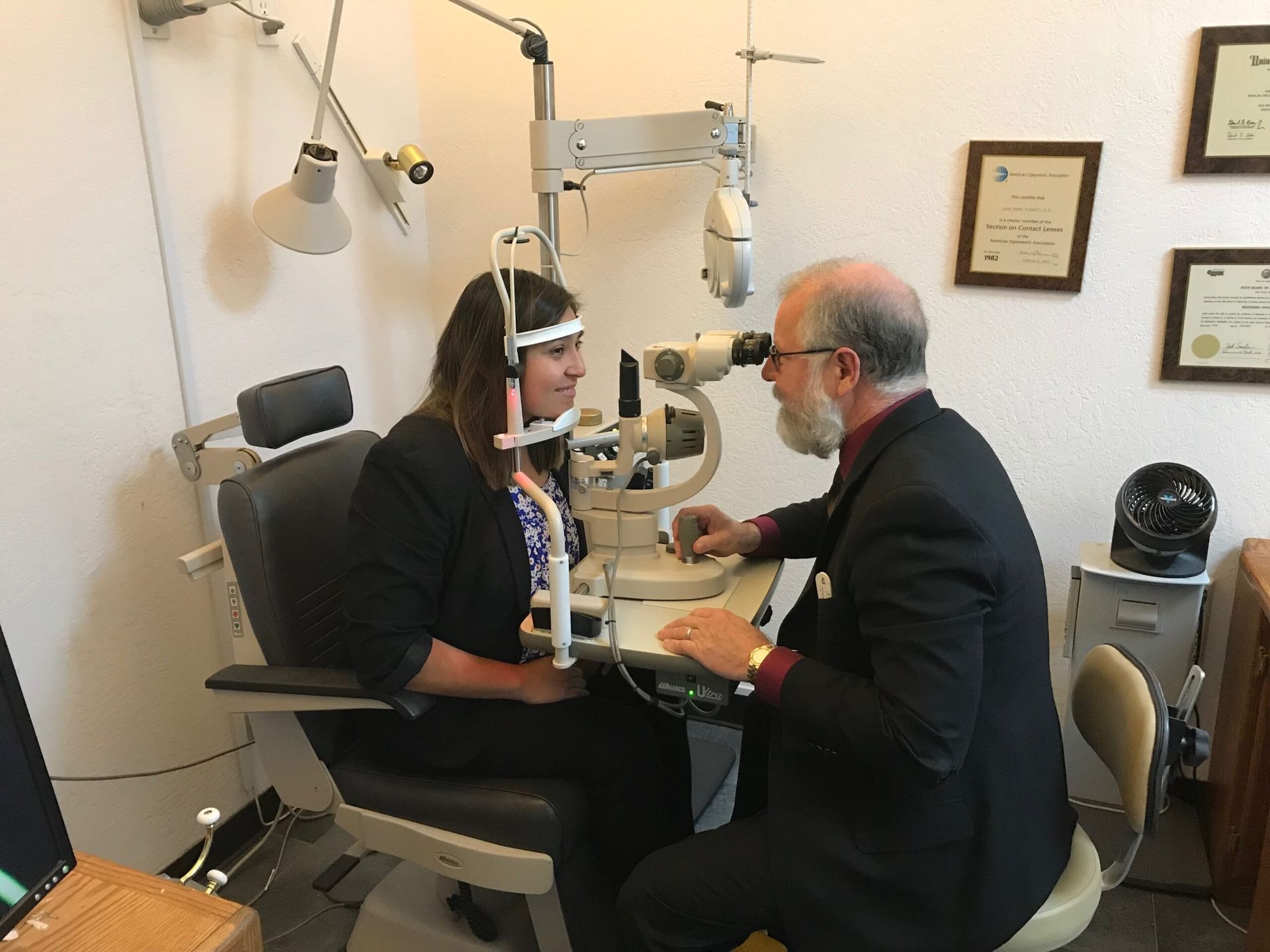
We examine the eye surface, the cornea, and the lids under magnification, and use a dye where appropriate to make surface damage visible.
The goal is to identify what is actually causing the redness. Where treatment is appropriate and within our scope, we provide it, and we refer when something needs care beyond it. See medical eye care.
Limiting the spread
If it is viral or bacterial, it spreads easily by hand contact:
- Wash your hands often, and avoid touching your eyes
- Do not share towels, pillowcases, or washcloths
- Change your pillowcase daily while it is active
- Throw out eye makeup that was in use
- Do not reuse contact lenses or the case from when symptoms began
- Wipe shared surfaces such as phones and door handles
Children can pass it through a household or classroom quickly. Ask us about returning to school or work rather than assuming.
What not to do
Do not use leftover prescription drops from a previous problem or from someone else. Drops for one cause can make another worse, and steroid drops in particular can cause harm if the cause is not what you assume.
Do not use redness-relief drops to mask it. They narrow blood vessels rather than treating anything, and redness often rebounds.
Common questions
How long is it contagious?
For viral conjunctivitis, often as long as the eye is red and watering. Ask us for guidance for your situation.
Do I need antibiotics?
Not always. Antibiotic drops do nothing for viral or allergic conjunctivitis, which is part of why identifying the cause first matters.
Can I go to work or school?
It depends on the cause and your setting. Ask us and we will advise.
Both eyes are itchy rather than sore.
That pattern usually points to allergy. See itchy, watery eyes: allergies or dry eye.
Does your staff speak Spanish?
Our entire staff is bilingual in English and Spanish. See bilingual eye care in Santa Maria.
Call us
If your eye is red and painful, or you wear contacts, call 805-925-9575 rather than waiting to see whether it settles.
Request an appointment or call 805-925-9575.